How PCB and PCBA Buyers Translate Market Signals Into Part-Level Supply Evidence
Strong semiconductor revenue and investment do not make every bill of materials easy to source. Growth can be concentrated in advanced logic, high-bandwidth memory, server DRAM, enterprise storage, and AI infrastructure while a PCBA project is delayed by one mature-node controller, sole-manufacturer connector, qualified analog device, specialized package, or part that is visible only through a source the project has not approved.
The correct question is not whether the semiconductor market is growing. It is whether every build-critical manufacturer part number in the released BOM can be obtained in the required quantity, from an acceptable source, on a date that supports assembly, programming, inspection, test, shipment, and the required service horizon. A market signal can start that review; it cannot complete it.
Information in this article was reviewed through October 4, 2026. Market data is used as planning context, not as a supplier quotation or a guarantee of price, lead time, allocation, source authorization, or delivery for a specific project.
The Short Answer
Semiconductor growth and BOM buildability are different measurements. Revenue and capital investment describe an industry, region, technology, or product category. A buildable BOM requires dated evidence for the exact orderable part, approved source, usable quantity, commercial terms, technical suitability, and project release status.
A useful sourcing review therefore works from the bottom up. It identifies the lines that can stop the build, tests each line against the current production plan, and separates visible stock from committed supply, a possible cross-reference from an approved alternate, and present availability from long-term continuity. A percentage of available BOM lines is not a release decision when the missing line blocks the product.
Why Semiconductor Growth Does Not Equal BOM Availability
Revenue Growth Does Not Show Exact Part Availability
WSTS reported exceptional semiconductor market growth in the first half of 2026, with memory identified as a major driver. That result describes aggregate shipment value across product groups and regions. It does not show whether a specific MCU, analog IC, power device, sensor, connector, oscillator, or memory suffix is available in the required package, grade, date, and quantity from an approved source.
Revenue can also move because of price, product mix, and higher-value devices rather than because every category has more interchangeable units. Use market growth to identify where conditions may be changing, then return to the exact BOM before making a purchasing or schedule commitment.
AI-Led Investment Is Concentrated
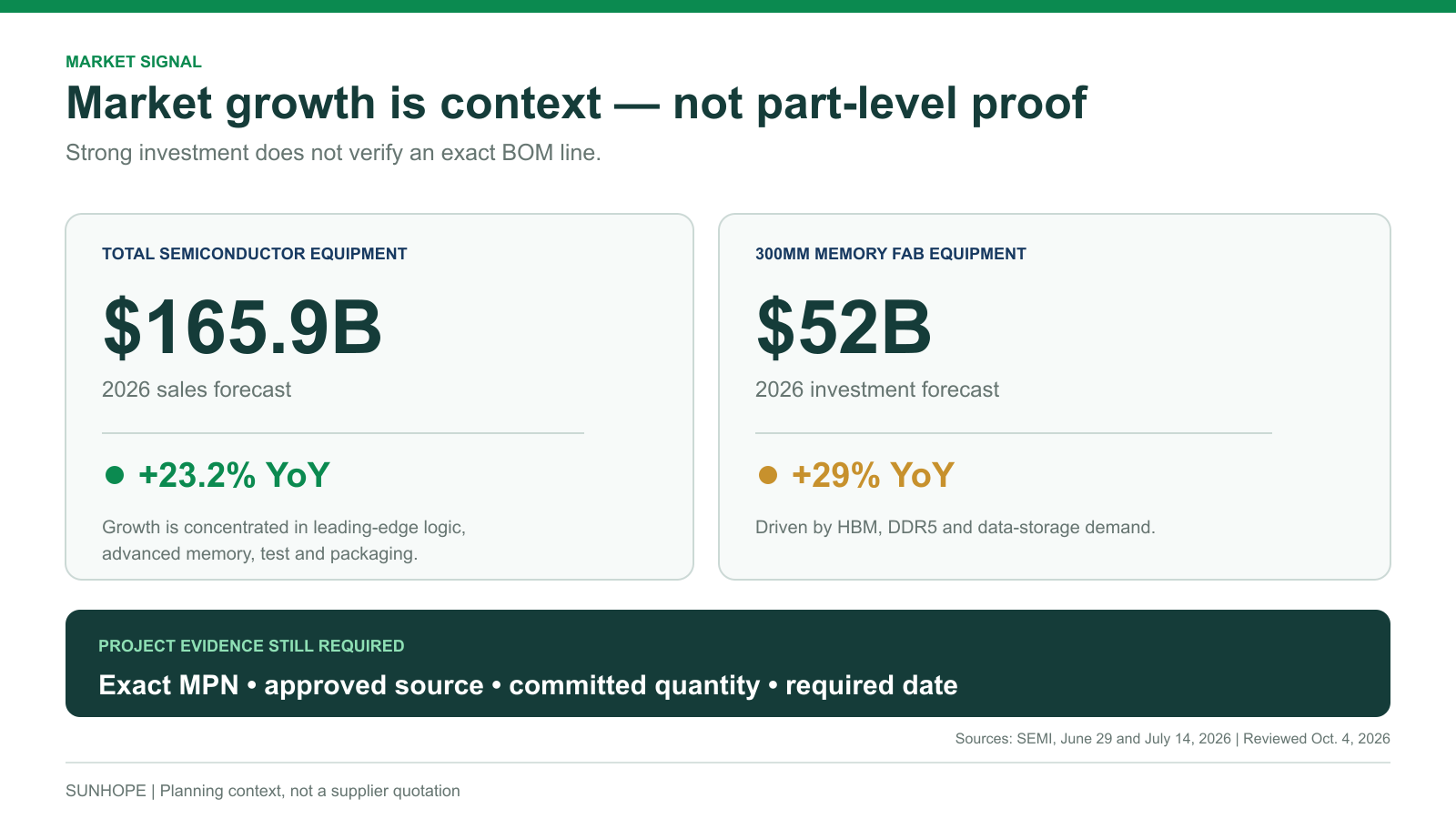
SEMI’s July 2026 forecast projected semiconductor manufacturing equipment sales of USD 165.9 billion for 2026, up 23.2% year over year, with leading-edge logic, advanced memory, test, and packaging among the principal growth areas. SEMI also projected 300 mm memory equipment investment to exceed USD 50 billion in 2026, supported by HBM, DDR5, AI accelerators, and data storage.
These figures confirm strong investment, but investment is not interchangeable supply. An industrial control BOM may depend on a mature-node transceiver, qualified power-management device, specific optocoupler, or long-life connector that does not share the same manufacturing route, allocation policy, package capacity, or economic priority as an AI device.
New Capacity Takes Time and Is Not Interchangeable
A new fab or production line must pass construction, equipment installation, process qualification, product transfer, yield ramp, packaging, final test, and customer qualification. Capacity for one wafer diameter, process node, device architecture, substrate, package, or grade cannot automatically produce another. More wafer output also does not resolve a separate shortage in substrates, assembly, package test, or qualified downstream capacity.
Treat capacity announcements as directional evidence for longer-range planning. For a current PCBA release, the controlling evidence is the exact orderable part number, source, committed quantity, requested date, quotation validity, and the conditions attached to that commitment.
One Critical Line Can Stop the Build
A BOM with nearly every line available can still be unbuildable. One missing controller can prevent programming; one connector can block enclosure integration; one safety-related component can invalidate approval evidence; and one unavailable memory device can stop functional test. The item’s unit price may be low while its schedule criticality is high.
Rank risk by what stops when a line is unavailable, not by component price or by the percentage of BOM lines already purchased. The practical unit of analysis is the released build and its dependencies.
Four Levels of Evidence From Market Growth to Build Readiness
Market evidence becomes useful only when each level leads to the next, more specific level. Skipping a level creates false confidence: a strong market can contain a weak category, a healthy category can contain a constrained part, and available material can still be unusable because the source or change has not been approved.
| Evidence level | What it can tell the buyer | What it cannot prove |
|---|---|---|
| Market revenue and investment | Direction of industry growth, regional activity, and concentrated investment | Availability, price, or delivery of an exact BOM line |
| Product-category conditions | Pressure in memory, logic, analog, power, passive, or interconnect categories | The correct package, grade, suffix, manufacturer, or approved source |
| Part-level sourcing evidence | Current source, quantity, lead time, lifecycle status, and commercial conditions | That the material is approved, reserved, and aligned to the build |
| Build-release evidence | Whether the approved BOM, material, validation, and schedule support production | Future continuity after the confirmed demand and service horizon |
The transition from category data to a production decision must be documented. A dated review should show which market signal triggered attention, which BOM lines may be exposed, what evidence was checked, which assumptions remain open, and who owns the next decision.
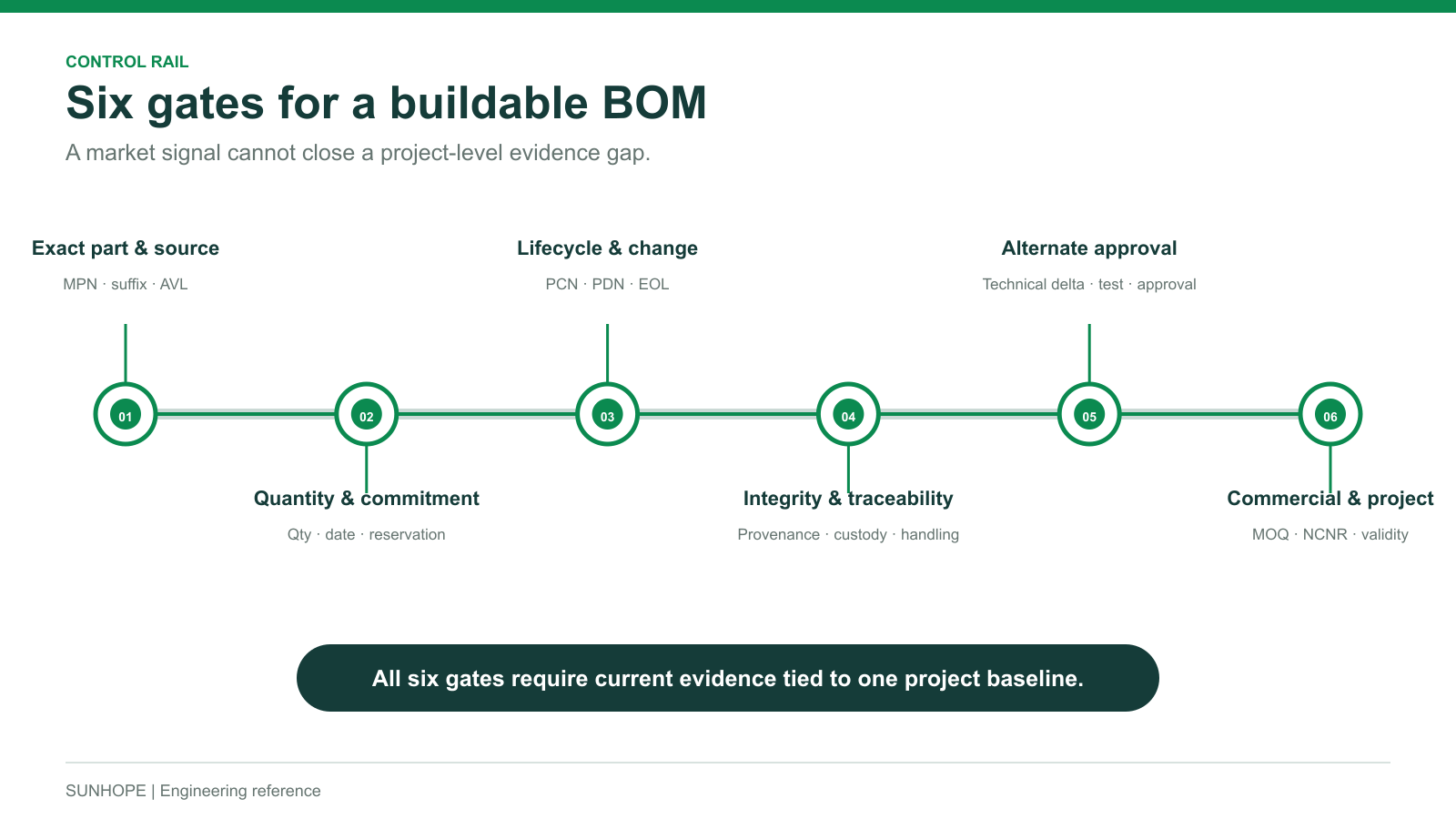
Six Gates for a Buildable BOM
Exact Part Identity and Approved Sources
Begin with the controlled BOM revision and the exact manufacturer part number, including package, temperature or qualification grade, packing suffix, and any customer-specific designation. Confirm whether the BOM permits one manufacturer, multiple approved manufacturers, or a specific approved-vendor list. A distributor count is not a manufacturer-source count, and a generic family name is not an orderable part.
Usable Quantity and Supply Commitment
Separate search-result visibility, distributor stock, a supplier quotation, material allocation, and a confirmed delivery commitment. Record the quantity, location, source, check date, quotation expiry, allocation condition, and date the source is prepared to support. Coverage should include the released build, expected attrition where applicable, approved service demand, and any quantity that cannot be cancelled or returned.
Published lead time is a planning input, not a promised delivery date. A line should be escalated when the project release will occur after the quotation expires, when the quantity is not reserved, or when the source cannot support the required date and documentation.
Lifecycle and Change Evidence
Texas Instruments distinguishes preview, active, not recommended for new designs, last-time buy, and obsolete status. Similar labels can differ by manufacturer, and family-level information may not describe every orderable suffix. Use the original manufacturer’s product page, PCN, PDN, or written confirmation as the primary evidence for the exact part.
For the full decision process covering shortage, allocation, NRND, last-time buy, EOL, alternate qualification, and redesign, use the detailed guide to electronic component obsolescence management for PCBA projects. This article uses lifecycle status only as one gate in the broader buildability decision.
Source Integrity Traceability and Handling
ECIA’s 2026 authorized-channel position emphasizes the product-integrity risks of gray-market procurement, including unknown provenance and improper storage or handling. Original manufacturers and authorized channels should therefore be the normal sourcing path. An independent or non-authorized source is an exception that requires defined provenance, custody, packaging, inspection, testing, quarantine, approval, and record controls appropriate to the project risk.
TI’s product shelf-life guidance also illustrates why an arbitrary date-code restriction is not a complete quality rule. Product construction, moisture sensitivity, packaging integrity, storage condition, and manufacturer guidance matter. Unnecessary restrictions can remove legitimate supply without reducing the actual project risk.
Alternate Approval and Validation Impact
A similar description or distributor cross-reference is not an approved substitute. Compare pinout, package dimensions, electrical limits, timing, startup behavior, thermal performance, moisture sensitivity, firmware interaction, programming, safety recognition, EMC, end-use qualification, and manufacturing or test effects. The required evidence depends on what changes and what the product must prove.
SUNHOPE does not replace a customer-approved component part number without customer approval. A proposal should identify the original and candidate parts, sourcing reason, technical differences, affected files, validation plan, permitted quantity or date range, approval owner, and effectivity record before the alternate reaches production.
Commercial and Project Conditions
Availability is not usable until the commercial conditions fit the project. Record MOQ, factory pack, price basis, currency, freight and tariff assumptions, NCNR terms, cancellation conditions, quotation validity, and ownership of excess or obsolete material. Compare the purchase commitment with forecast, firm orders, warranty, repair, and service demand.
The buyer should also distinguish requested delivery from evidence-supported delivery. Material commitments, bare-board delivery, fixture or program readiness, inspection resources, and functional-test capacity must align to one build schedule before the date is treated as firm.
How BOM Risk Changes a PCBA Project
Quotation Confidence
A PCBA quotation is only as reliable as its sourcing assumptions. For each risk line, distinguish current authorized stock, a manufacturer or distributor quote, historical cost, and an uncommitted market check. State which lines are firm, which require reconfirmation, and which conditions allow repricing or schedule change.
Prototype and Pilot Build Validity
A prototype may be completed with temporary material that cannot support qualification or repeat production. Label every sourcing deviation and decide whether it is acceptable only for engineering learning or can become part of the production baseline. The wider release process is covered in the prototype to production ready PCBA guide.
Production Scheduling and Material Readiness
Do not reserve an assembly window on the assumption that visible material will arrive. Confirm build-critical components, bare PCBs, programmed devices, special processes, fixtures, and test inputs against the same revision and schedule. Late material can cause partial builds, repeated line setup, additional handling, and an invalid production baseline even when the overall market is expanding.

Programming Inspection and Functional Test Impact
A component change can alter firmware, programming files, power-up behavior, AOI or X-ray criteria, fixture interfaces, expected measurements, and test limits. Those changes must be evaluated before release, not discovered after assembly. See PCBA functional test requirements before quotation for the required inputs, ownership, validation, and acceptance controls.
Actions by Project Stage
| Project stage | Required review | Release evidence |
|---|---|---|
| Product design and RFQ | Check lifecycle, approved sources, package availability, qualification, demand, and alternate strategy | Controlled BOM plus a dated list of critical lines and open assumptions |
| Prototype and pilot | Confirm production-intent material; label temporary sourcing or technical deviations | Availability check, deviation record, validation plan, and approval status |
| Repeat production | Recheck critical lines, committed stock, open notices, quotation validity, and demand coverage | Dated BOM review tied to the released files, quantity, and schedule |
| Disruption or change | Define affected MPNs; compare remaining stock, LTB, alternate, redesign, and validation options | Option analysis, customer decision, updated records, and approved effectivity |
Do not collapse these decisions into one undifferentiated risk score. An unapproved source, missing safety evidence, unavailable programmed device, or substitute that changes firmware may block release regardless of the numeric total. Use scores for prioritization only after release-blocking gates are visible.
What a Decision Ready BOM Review Should Contain
Before approving a PCBA quotation or production release, the project record should make the following information visible for each critical or exceptional line:
- Controlled BOM revision, exact manufacturer part number, package, grade, and orderable suffix.
- Approved manufacturer and source rules, including do-not-substitute conditions.
- Original-manufacturer lifecycle evidence, source, check date, and any open PCN or PDN impact.
- Usable and committed quantity, quoted lead time, delivery basis, validity, and allocation condition.
- MOQ, NCNR, price-change conditions, excess-material ownership, and demand horizon.
- Approved alternatives, unapproved candidates, required validation, decision owner, and approval status.
- Open exceptions, responsible owner, decision deadline, and the next date the evidence must be checked.
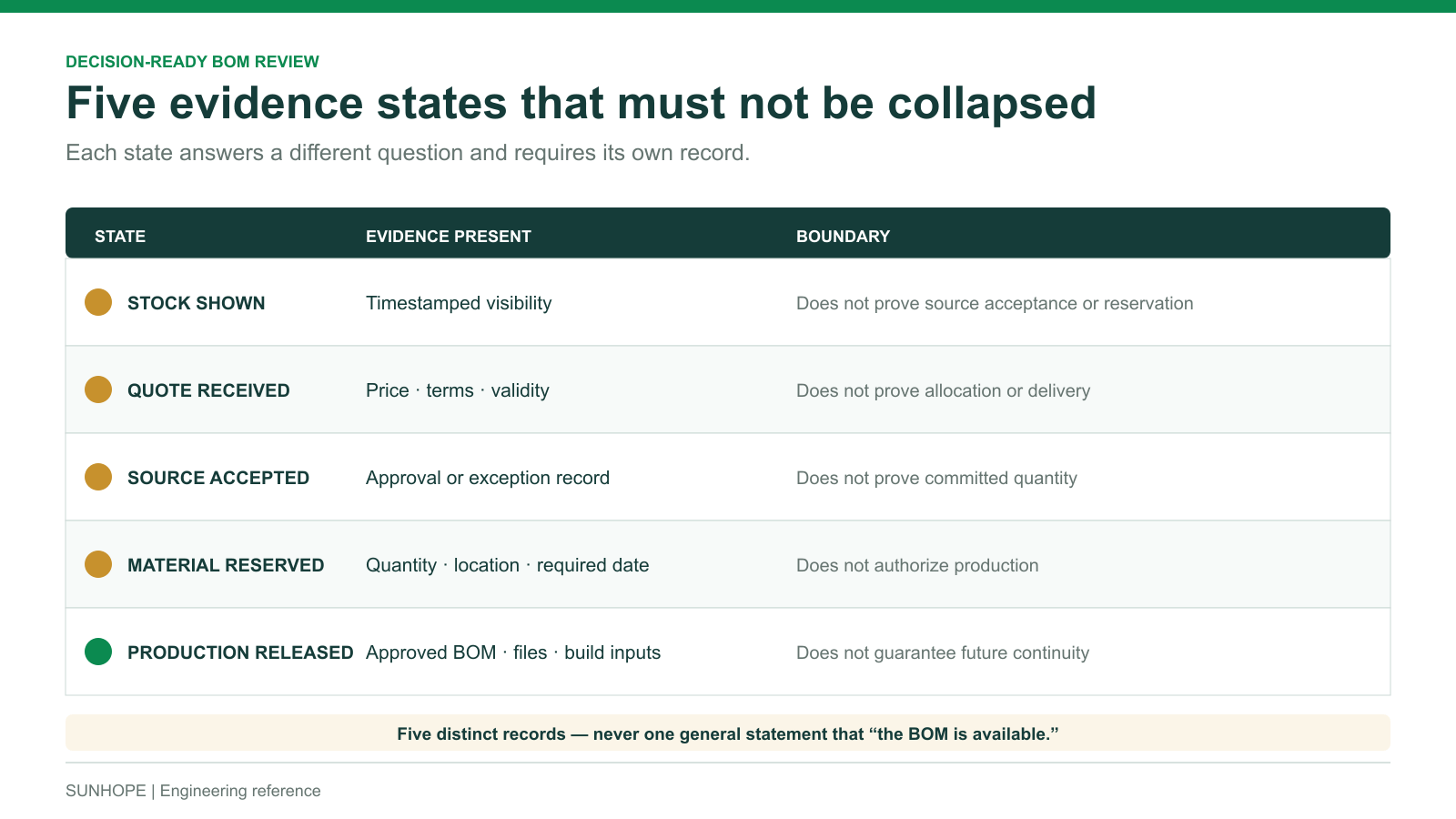
The output should distinguish facts from assumptions. ‘Stock shown,’ ‘quote received,’ ‘source accepted,’ ‘material reserved,’ and ‘production released’ are different states and should not be represented by one general statement that the BOM is available.
What Buyers Should Not Infer From Market Growth
- More semiconductor revenue does not mean every component is available.
- More fab investment does not provide immediate relief for every node, package, grade, or orderable suffix.
- Distributor search results do not prove source approval, material reservation, or long-term continuity.
- A form-fit-function comparison does not by itself create an approved production substitute.
Frequently Asked Questions
Why Can a BOM Remain Difficult to Source During Semiconductor Market Growth?
Growth can be concentrated in AI-related logic, memory, storage, and infrastructure while a BOM depends on mature-node, specialty, low-volume, qualified, or sole-manufacturer products. Aggregate revenue also does not show the package, grade, approved source, committed quantity, or lifecycle condition of an exact MPN.
Does Distributor Stock Mean a Component Is Ready for Production?
No. Confirm the exact orderable code and quantity, manufacturer authorization or approved exception path, custody and traceability, packaging and storage condition, quotation validity, material reservation, and alignment with the released build. Visible stock can disappear or fail the project’s quality and approval rules.
Which BOM Lines Should Be Reviewed First?
Start with lines that combine high build criticality and weak recovery options: single-approved-MPN or single-manufacturer parts, allocation-controlled or long-lead items, specialized packages or grades, open lifecycle notices, and components whose replacement affects the PCB, firmware, programming, functional test, safety, EMC, or regulatory evidence.
When Does an Alternate Require Customer Approval and Validation?
Any change outside the customer’s approved BOM or alternate rules requires customer approval before production use. Validation scope depends on the technical and manufacturing differences. It may include document review, first article, firmware or programming checks, electrical and functional testing, reliability evidence, safety or EMC review, and updates to the controlled production baseline.
Next Step for a PCBA Project
For a project-specific review, provide the controlled BOM with exact manufacturer part numbers, approved-source and substitution rules, build quantities and dates, annual and service demand, product-life expectation, known notices, test requirements, and customer change-control conditions. These inputs allow market signals to be tested against the actual build instead of applied as general assumptions.
Review SUNHOPE’s PCBA technical capabilities, PCB and PCBA quality assurance process, or contact PCBA manufacturing support team. Component sourcing coordination is provided within the manufacturing project, not as standalone distribution.