Component obsolescence cannot be resolved by selecting any part that appears to fit the footprint. In a PCBA project, the work begins with confirming the lifecycle event and exact manufacturer part number. The project team must then compare commercially realistic responses, assess product and manufacturing effects, obtain the required customer approval, and release every affected record before the change reaches production.
A temporary allocation, a not-recommended-for-new-designs status, and a formal product discontinuation notice create different decision windows. The response also depends on project stage, remaining service life, authorized inventory, qualification effort, compliance exposure, and material ownership. This guide presents a closed-loop method for managing those decisions within a PCBA project.
Distinguish Shortage Allocation NRND Last Time Buy and EOL
Define Each Condition and Its Decision Window
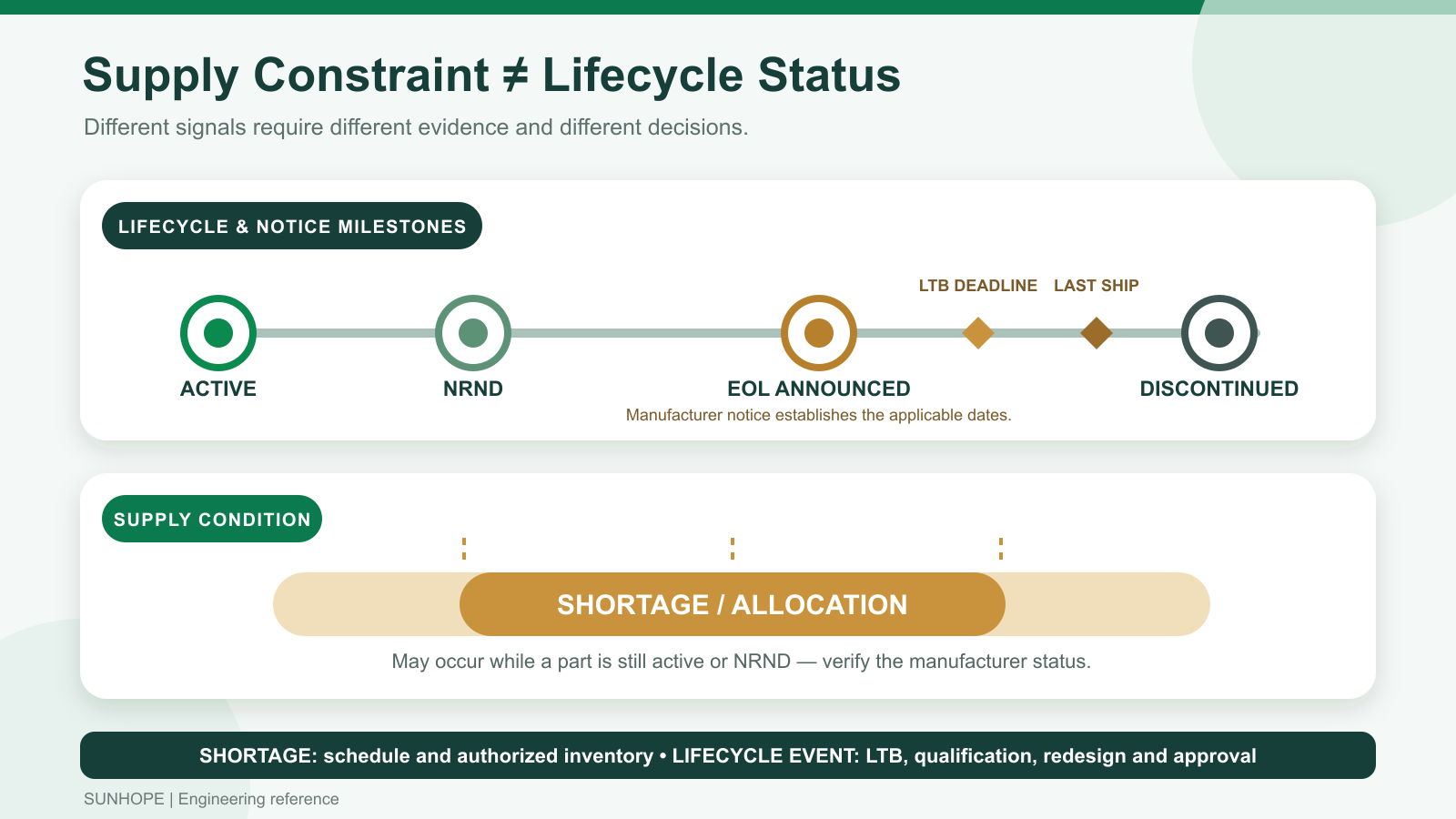
Use the manufacturer’s terminology and the exact orderable part number. A lifecycle label applied to a product family may not cover every package, temperature grade, qualification grade, packing suffix, or custom version. The status must therefore be checked at suffix level whenever the manufacturer provides that detail.
A shortage or allocation does not prove that the manufacturer has stopped the product. NRND signals increasing design risk while the part may remain orderable. A last-time-buy notice creates a final ordering window, while obsolete or discontinued status means normal manufacturer supply has ended or is ending. The table below links each condition to its normal first response.
| Condition | Meaning for the PCBA project | Typical first response |
|---|---|---|
| Shortage or allocation | Supply or lead time is temporarily constrained while the lifecycle may remain active. | Confirm the need date, authorized stock, delivery alternatives, and schedule exposure. |
| NRND | The part may still be manufactured, but lifecycle risk is increasing. | Avoid it in a new design where practical and prepare an alternate strategy for existing products. |
| Last time buy | The manufacturer has established a final order window. | Model remaining production, repair, warranty, and service demand before committing inventory. |
| Obsolete or discontinued | Normal manufacturer supply has ended or is ending. | Escalate sourcing, qualification, redesign, approval, and inventory decisions. |
Why Temporary Shortage and Permanent Discontinuation Require Different Responses
A shortage may be managed through schedule alignment, demand consolidation, authorized distributor inventory, allocation planning, or a time-limited approved alternate. Permanent discontinuation changes the long-term design and service strategy. Treating a shortage as EOL can create unnecessary engineering work and inventory. Treating an EOL notice as a temporary shortage can consume the remaining decision window and leave the program dependent on stock whose source, quantity, or condition cannot be verified.
Identify and Prioritize Obsolescence Risk in the BOM
Verify the Exact Part Status Sources Inventory and Application Criticality
Begin with the manufacturer part number, including package, temperature grade, qualification grade, packing suffix, and any customer-specific designation. For each critical line, review manufacturer status, approved source count, lead time, usable inventory, approved alternates, production and service demand, and application criticality.
Do not use distributor search-result counts as the source count. Several distributors may hold material from one original manufacturer, and multiple listings can refer to the same lot. Source diversity means that more than one technically acceptable and approved manufacturing source can support the requirement.
Record the Source and Date of Every Status Check
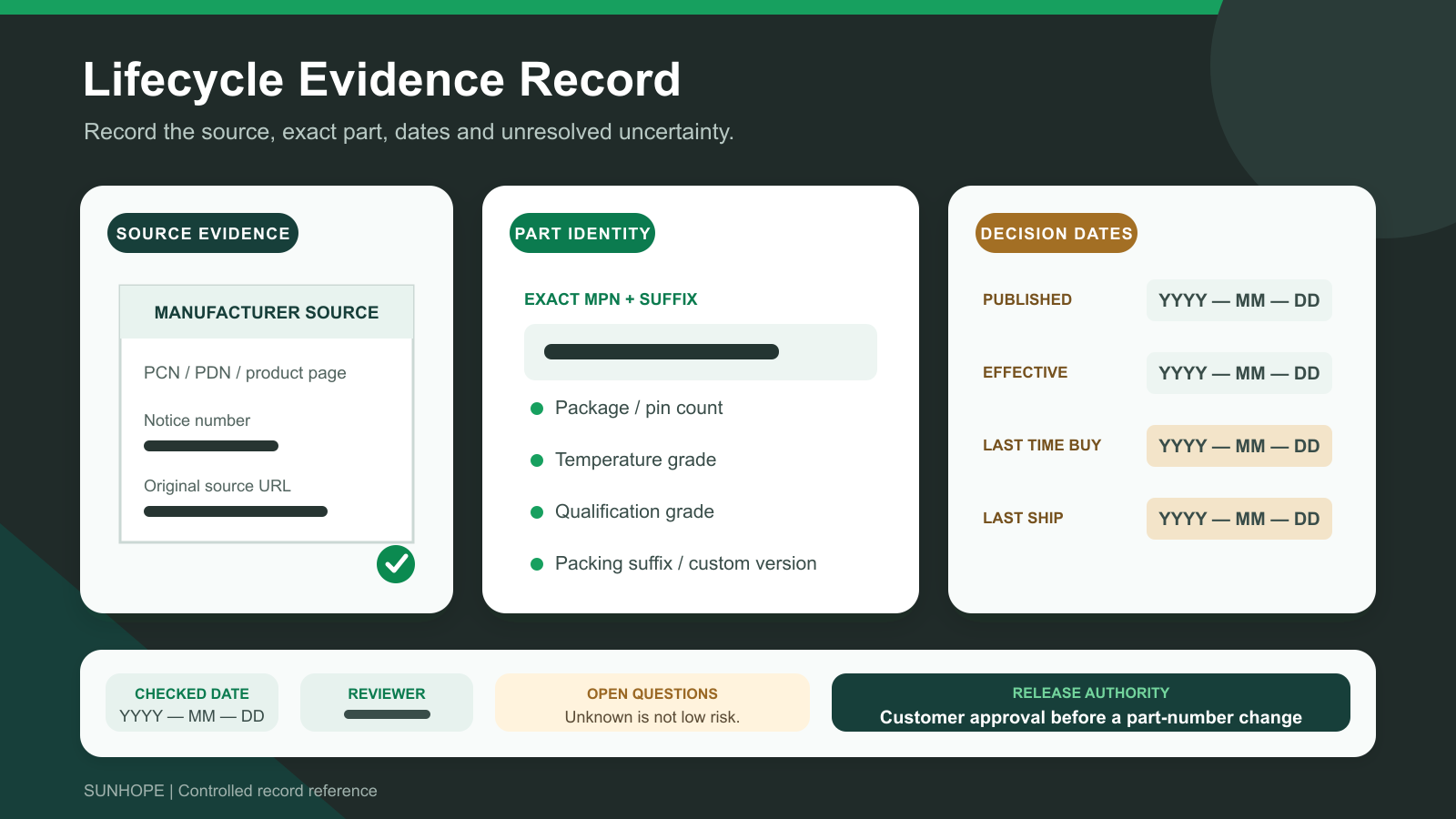
Lifecycle information changes over time. Record the original manufacturer page or notice, notice number, exact affected MPN, publication and effective dates, last-time-buy and last-time-ship dates, status-check date, reviewer, and unresolved uncertainty. A downloaded notice supports the audit trail but should still identify the original source and exact part number.
Apply a Risk Matrix With Defined Anchors and Escalation Gates
A risk score helps rank BOM lines but does not replace engineering judgment. The following 1, 3, and 5 anchors illustrate one method. Define intermediate scores before use, retain the evidence behind each rating, and calibrate the model to the product and contract. Never score an unknown condition as low exposure.
| Dimension | Score 1 lower exposure | Score 3 moderate exposure | Score 5 higher exposure |
|---|---|---|---|
| Lifecycle | Active and recommended for new designs | Mature, NRND, or a change notice needs review | LTB window closing, obsolete, or discontinued |
| Source exposure | Multiple approved manufacturers | One approved manufacturer plus a credible candidate | Single source with no qualified alternate |
| Lead time | Stable and within the planning window | Variable or close to the need date | Beyond the need date or allocation controlled |
| Usable stock | Traceable stock covers demand with margin | Partial coverage or uncertain forecast margin | No verified stock or unacceptable handling condition |
| Substitution difficulty | Prequalified drop-in alternate | Engineering comparison and limited changes required | Layout, architecture, firmware, or interface change |
| Validation impact | Manufacturing confirmation only | First article and targeted regression testing | Safety, EMC, reliability, or regulatory requalification |
Check escalation gates before interpreting a total score. A safety-related function, software-bound MCU, sole-source custom device, isolation component, or compliance-sensitive power part may require immediate action even when the numeric total is moderate. The same applies when an LTB deadline will expire before normal review can be completed.
Prioritize by Project Stage and Remaining Service Life
During design, remove NRND or fragile single-source parts before layout freeze when the change cost is lowest. Before quotation or NPI, resolve BOM lines that can invalidate price, lead time, or the proposed build schedule. During a pilot build, preserve the approved validation baseline and avoid uncontrolled substitutions. For repeat production, compare the remaining production and service horizon with the time needed to qualify an alternate or redesign.
This review should connect to the wider prototype-to-production readiness process so that material, design, manufacturing, firmware, and test decisions converge on one approved release.
Monitor PCNs PDNs and Manufacturer Lifecycle Evidence
Use Original Manufacturer Evidence as the Primary Source
Subscribe to original component manufacturer notifications for critical parts and retain the actual Product Change Notification or Product Discontinuation Notice. Review the affected orderable part numbers, change type, reason, dates, replacement recommendation, qualification information, and required customer action. A PCN may address a wafer process, assembly site, material, package, marking, test method, or another controlled change; it is not automatically a discontinuation.
Notification practices vary by manufacturer, so confirm the actual notice rather than relying on a normalized label. For example, Texas Instruments publishes product change and withdrawal information through its PCN process.
Use Aggregators for Screening Rather Than Final Approval
Lifecycle databases, distributor tools, and BOM-analysis platforms are useful for screening a large BOM and detecting signals. They may lag the manufacturer, normalize different terminology, omit suffix-level distinctions, or combine commercial availability with lifecycle status. Use them to open a review. Base the formal project decision on the original manufacturer notice, product page, or documented manufacturer confirmation, and record when that evidence was checked.
Treat Suggested Replacements as Qualification Candidates
A part listed as a replacement in a discontinuation notice is not automatically approved. NXP states in its discontinuation notices that a replacement designation does not warrant equivalent form, fit, function, or performance until the customer qualifies it. The same discipline should be applied regardless of manufacturer: a cross-reference identifies a candidate for review, not permission to change the BOM.
Compare Last Time Buy Alternate Qualification and Redesign
Compare Total Program Exposure Rather Than Unit Price Alone
The practical choices are a last-time buy, alternate qualification, redesign, or a staged combination. Compare them across the production and service horizon, including forecast confidence, inventory, order and ship deadlines, storage, engineering work, PCB and firmware changes, test, compliance, old-stock disposition, and schedule risk.
| Option | When it can fit | Main exposure | Evidence required |
|---|---|---|---|
| Last time buy | Remaining life is limited and demand can be forecast with acceptable confidence. | Cash, forecast error, excess, loss, storage, shelf life, and traceability. | Demand model, deadlines, storage plan, ownership, purchase approval, and disposition rule. |
| Alternate part | A technically suitable device can be qualified without a fundamental product redesign. | Engineering comparison, samples, manufacturing validation, test changes, and compliance impact. | Datasheet comparison, risk review, validation plan, approved results, and effectivity. |
| Redesign | The remaining service life is long or no acceptable alternate can support the requirement. | NRE, schedule, PCB and firmware changes, tooling, test, and product requalification. | Released design package, verification and validation evidence, approvals, and transition plan. |
Recognize When an Option Becomes Impractical
- Escalate an LTB when demand is too uncertain, the purchase exceeds the approved commercial exposure, storage controls are inadequate, or final-order and final-ship terms cannot be confirmed.
- Escalate an alternate when key parameters lack evidence, the device changes software or compliance behavior, the application exceeds a rating, or samples cannot be obtained in time for validation.
- Escalate a redesign when the change affects architecture, PCB layout, mechanical fit, firmware, safety, EMC, regulatory evidence, tooling, or customer delivery commitments.
A temporary LTB may be used to protect near-term production while an alternate or redesign is qualified. If this staged response is selected, define which demand the LTB covers, who owns the inventory, when the new design becomes effective, and what happens to residual stock.
Qualify an Alternate Beyond Form Fit and Function
Review Electrical Thermal Timing Firmware and End Use Effects
Form, fit, and basic function are an opening screen. Compare maximum ratings, operating conditions, tolerances, startup and shutdown behavior, transient and thermal performance, signal thresholds, timing, protection functions, package construction, moisture sensitivity, finish, temperature grade, and qualification grade. For programmable devices, also review register behavior, boot sequence, firmware libraries, security, calibration, errata, and programming tools.
Compliance impact is product specific. A component change can affect safety spacing or protection, EMC behavior, environmental declarations, product approvals, or customer-specific qualification. The customer or designated design and compliance owner must decide whether existing evidence remains valid and what testing must be repeated.
Review Manufacturability Inspection and Test Impact
The alternate must also fit the manufacturing process. Review land pattern, stencil and paste behavior, package height, polarity, marking, placement vision, reflow or selective-solder conditions, cleaning, inspection visibility, X-ray need, AOI libraries, programming, ICT access, functional-test limits, and repair instructions. Determine whether the change requires a sample build, first article, pilot lot, targeted regression, environmental or reliability testing, or renewed compliance testing.
When the change affects stimuli, loads, interfaces, firmware, measurements, or acceptance limits, update the PCBA functional test requirements before quotation and revalidate the fixture or program before production release.
Control Supply Authenticity and Traceability When Authorized Stock Is Limited
Prioritize Original Manufacturers and Authorized Channels
Use the original component manufacturer or its authorized distribution channel wherever feasible. Authorized sourcing provides the clearest route to manufacturer-backed provenance, handling controls, notices, warranty, and commercial support. The industry resources maintained by the Electronic Components Industry Association connect authorized distribution, PCN practice, traceability, and counterfeit-risk controls.
See the ECIA quality resources for related industry references. A reference to those standards should not be interpreted as a claim that SUNHOPE holds a certification that has not been independently confirmed.
Open a Controlled Exception for Independent Sources
When authorized stock cannot meet the approved need date, urgency should not silently lower the sourcing standard. Open an exception that identifies the exact part, quantity, proposed source, urgency, authorized-channel checks, alternatives considered, application risk, inspection and test plan, segregation method, disposition authority, commercial terms, and required customer approval.
Collect available chain-of-custody records, supplier assessment, lot and date codes, packaging and labeling evidence, certificates, storage history, samples, and return terms. Define inspection or testing that is proportionate to the part and application. Visual inspection alone cannot establish authenticity or full performance.
The principles in SAE AS5553 emphasize reliable sources, authenticity and conformance, risk control, and disposition of suspect material. Independent-source testing can reduce defined risks, but it cannot convert the source into an authorized channel or recreate missing chain-of-custody evidence. High-consequence projects may reject untraceable material regardless of test results.
Move the Change Through Customer Approval and Define Decision Rights
SUNHOPE Does Not Change Approved Part Numbers Without Customer Approval
SUNHOPE does not replace an approved component part number on its own authority. The sourcing team may identify a risk, engineering may compare candidates, and manufacturing may assess process and test impact, but the customer must approve the part-number change before the alternate is released to purchasing and production. Schedule pressure, stock availability, or a distributor cross-reference does not override this rule.
Document the Evidence Decision Conditions and Effectivity
The change request should identify the original and proposed part numbers, manufacturer, lifecycle or supply reason, affected assemblies and revisions, authorized stock position, commercial impact, technical comparison, validation scope and results, compliance assessment, open risks, proposed effective date or lot, and affected records. Capture the customer decision, conditions, approver, approval date, and approval reference.
If approval is limited to one build, quantity, source, date code, or production site, record that boundary. A temporary exception must not become a permanent undocumented alternate. Purchasing and production should receive only the released decision and its conditions.
Clarify Responsibility for Each Build Model
For a turnkey build, SUNHOPE can monitor the quoted BOM, source approved material, raise lifecycle and availability risks, propose options, and control the stock it purchases. The customer still approves part-number changes, exceptional sources, validation scope, LTB commitments, and excess-inventory disposition.
For a partial-turnkey build, responsibility should be assigned by BOM line. Each party must know who monitors notices, buys material, approves changes, and owns shortages or excess. For a consigned build, SUNHOPE can receive, verify, store, issue, and report customer-owned material within the agreed scope; lifecycle monitoring and supply ownership remain with the customer unless the contract assigns them otherwise.
Component coordination should remain part of the SUNHOPE PCBA manufacturing support process. The output is an approved manufacturing baseline with traceable material and controlled records, not a standalone list of components for sale.
Anonymized Representative PCBA Obsolescence Case
Releasing an Isolated RS-485 Transceiver Change for a Long-Life Industrial Control Board
This representative case illustrates a controlled workflow that can be supported within SUNHOPE’s PCB and PCBA manufacturing scope. It does not identify a customer, disclose an exact part number, or claim an unverified performance result.
Project Context and Lifecycle Event
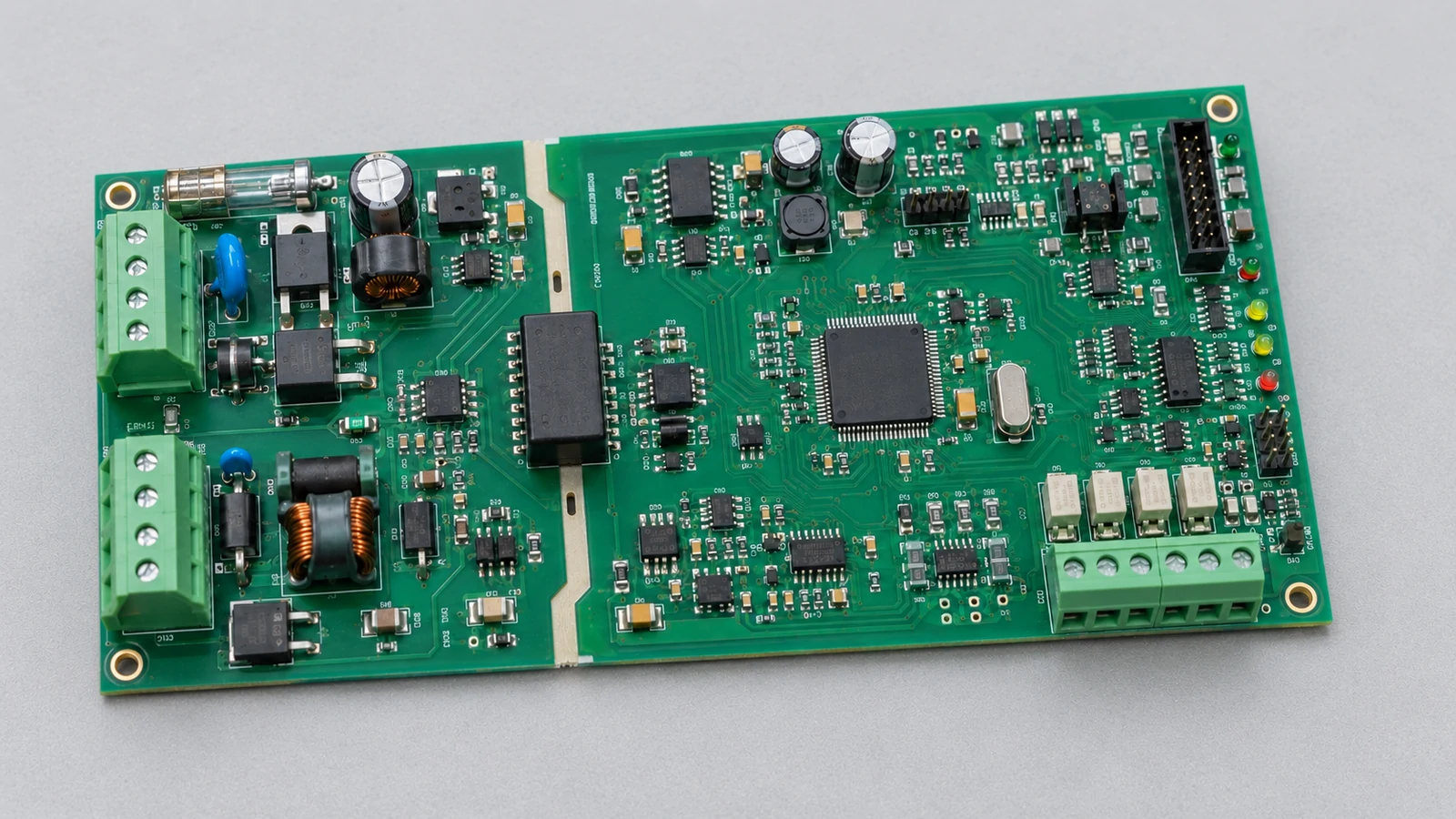
A four-layer industrial control PCBA used an isolated RS-485 transceiver between a field interface and the main controller. The assembly was in repeat production with several years of production and service remaining. The manufacturer issued a discontinuation notice with last-time-buy and last-time-ship dates. Authorized stock covered near-term builds but not the combined production, repair, warranty, and service horizon.
The manufacturer named a replacement candidate. The package and headline function appeared compatible, but the notice did not establish automatic equivalence. The application depended on isolation performance, common-mode behavior, receiver failsafe thresholds, propagation delay, temperature grade, and stable communication under the customer’s cable and loading conditions.
Options and Decision Evidence
SUNHOPE structured three options for customer review. An LTB could protect near-term production but carried forecast, excess, and storage exposure. A pin-compatible candidate could avoid a PCB revision if qualification confirmed its behavior. A different device family could improve the supply horizon but would change the layout and expand EMC and product-validation work.
The project team recorded the original discontinuation notice, exact suffix, authorized stock, demand assumptions, final order and delivery dates, and the technical gaps for the candidate part. The customer selected a staged response: purchase an approved quantity of original material for immediate demand while qualifying the candidate for later builds. The customer retained ownership of the LTB commitment and the design-approval decision.
Technical and Manufacturing Validation
The comparison covered supply range, thresholds, driver output, receiver failsafe behavior, propagation delay and skew, isolation rating, creepage and clearance, transient immunity, temperature grade, package, moisture sensitivity, marking, and manufacturer qualification information. The customer’s design authority determined the system and compliance tests required for the end use.
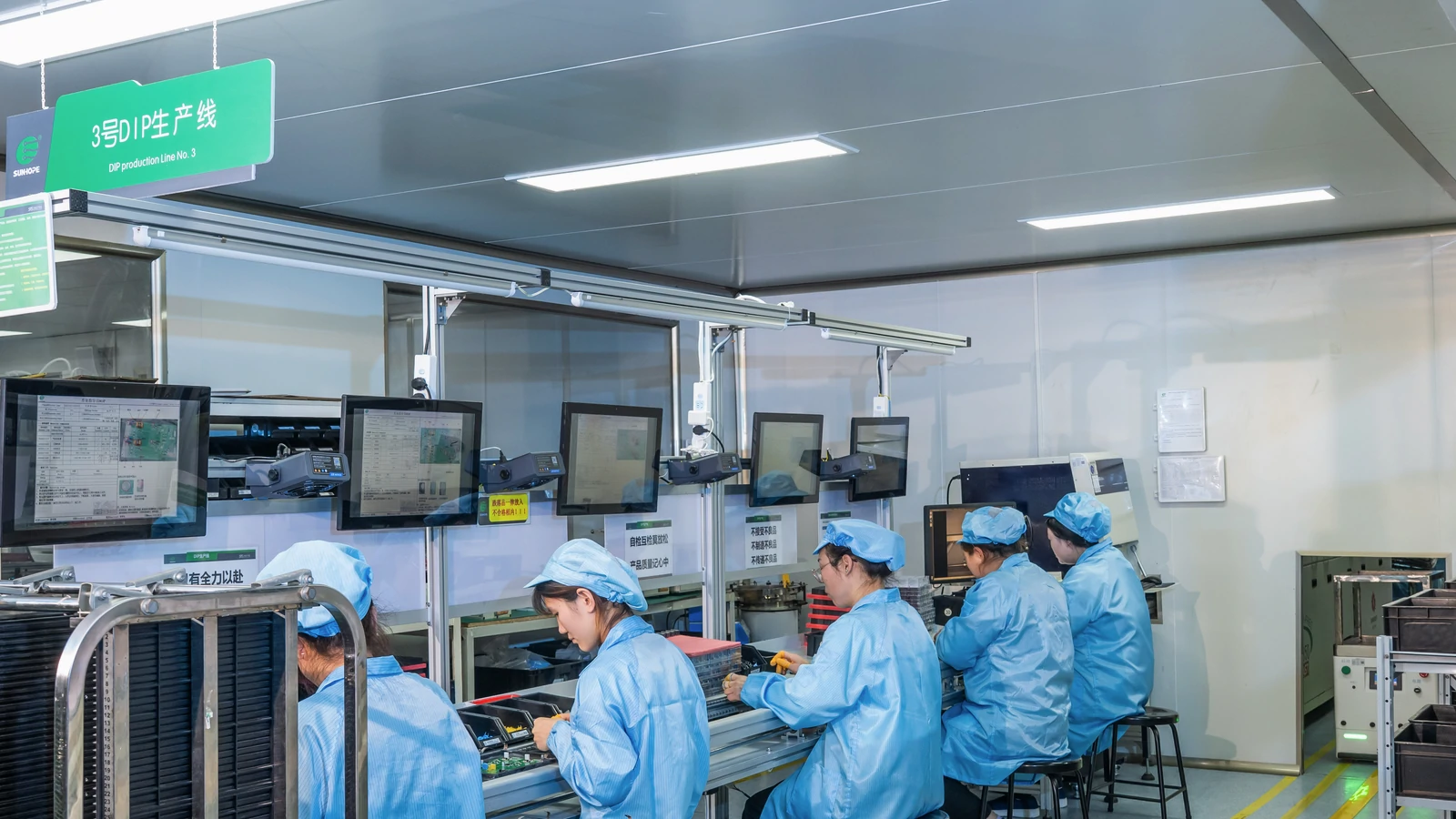
SUNHOPE reviewed the land pattern, polarity, package height, stencil opening, placement data, reflow compatibility, AOI visibility, and X-ray need. A controlled first-article build used traceable authorized samples. Inspection verified package orientation and soldering. Functional testing exercised communication in both directions at the approved supply and load conditions, checked startup and failsafe behavior, and recorded results against customer-approved limits. Any product-level environmental, EMC, isolation, or regulatory testing remained under the customer’s defined validation plan.
Approval Production Release and Traceability
After the approved evidence was complete, the customer authorized the alternate with a defined production effectivity. SUNHOPE updated the controlled BOM and CPL, placement data, assembly information, AOI library, receiving criteria, and relevant functional-test records. Original and alternate stock remained segregated by manufacturer part number and lot. The release record identified which build first used the alternate and how the remaining original stock would be consumed or reserved for service.
The project closed only after purchasing, production, inspection, test, inventory, and released files agreed. The result was a controlled transition supported by evidence and customer approval, rather than an availability-driven substitution.
Update the Production Baseline and Control Repeat Builds
Release All Affected Records Together
After approval, update the controlled BOM and approved component list, including the manufacturer part number, conditions of use, effectivity, and revision. Update the schematic, PCB layout, assembly drawing, AVL data, purchasing specification, work instruction, stencil or reflow information, AOI or X-ray library, programming file, firmware dependency, fixture file, ICT or functional-test limit, label, declaration, and compliance evidence wherever the change has an effect.
Do not update the BOM while leaving an old drawing, test limit, or firmware package on the production floor. Release the affected records as one baseline so that purchasing and production can build only the approved configuration. The controlled set should answer which part was used, why it was selected, who approved it, when it became effective, which units received it, and which evidence supported the decision.
The receiving, inspection, traceability, nonconformance, and record controls should align with the SUNHOPE PCB and PCBA quality assurance process.
Reassess Critical Parts Before Repeat Production
Set a review cadence based on product consequence, remaining lifecycle, BOM volatility, source exposure, and build frequency. High-risk parts may need event-driven monitoring plus scheduled review; stable commodity lines may be reviewed less frequently. Assign who receives notices, screens the BOM, verifies manufacturer status, updates the risk record, communicates demand, proposes mitigation, approves commitments, and closes the change record.
Before each repeat build, recheck critical and previously flagged lines rather than assuming the last status remains valid. Confirm the manufacturer status and date, approved source, current lead time, on-hand and committed stock, shelf-life or handling condition, open PCNs or PDNs, approved alternates, document revision, and any expired validation or changed end-use requirement. Hold the release when new information breaks the approved baseline.
Component Obsolescence Management Checklist
A component-change project is not closed when an alternate is found. It is closed when source evidence, risk judgment, technical and manufacturing validation, customer approval, inventory action, and released production files agree.
| Step | Required output | Release question |
|---|---|---|
| 1 Source | Manufacturer status or notice, exact MPN, original source, and check date. | Is the evidence current and part-number specific? |
| 2 Judge risk | Lifecycle and supply rating, application criticality, and escalation gates. | What happens to schedule, product, service, and compliance if no action is taken? |
| 3 Compare options | LTB, alternate, redesign, or staged-response comparison. | Which option is viable across demand, cost, time, and residual risk? |
| 4 Validate | Approved technical, manufacturing, test, and compliance plan with results. | Does the evidence cover every affected product and production requirement? |
| 5 Approve | Customer decision with scope, conditions, effectivity, approver, and reference. | Has the customer explicitly approved the part-number change or source exception? |
| 6 Update | Released BOM, CPL, design, test, inventory, and traceability records. | Can purchasing and production build only the approved baseline? |
| 7 Monitor | Named owner, notice subscription, demand horizon, and next review date. | Will the next lifecycle or supply change reopen the review in time? |
Frequently Asked Questions
Is NRND the Same as EOL?
No. NRND discourages use in a new design while the part may remain orderable. EOL or discontinuation means normal production or supply is ending or has ended. Confirm the manufacturer’s terminology and exact part number.
Should We Make a Last Time Buy as Soon as an EOL Notice Appears?
Not automatically. Compare remaining demand, forecast confidence, stock, order and ship deadlines, storage, commercial exposure, alternate qualification, and redesign timing. Obtain the required approvals before committing inventory.
Can a Distributor Cross Reference Be Approved as a Drop In Replacement?
No. A cross-reference is a candidate for review. Qualification must address product, manufacturing, test, reliability, compliance, and end-use effects before customer approval.
Who Approves a Component Substitution in a SUNHOPE PCBA Project?
The customer approves the part-number change. SUNHOPE can identify risk, organize evidence and options, assess manufacturing impact, support approved validation, and update manufacturing records.
What If Authorized Stock Is Not Available?
Open a controlled exception covering source, provenance, application risk, inspection and test scope, segregation, traceability, commercial terms, and residual risk. Use the material only after the required authorization; some products should reject untraceable material regardless of test results.
How Often Should a BOM Be Reviewed for Obsolescence?
Use a risk-based cadence and event-driven review. Recheck critical lines before repeat-production release and whenever a PCN, PDN, shortage, source change, demand change, or design revision affects the approved baseline.
Next Step for a PCBA Project
For a project-specific review, provide the current BOM with exact manufacturer part numbers, approved-source rules, build schedule, annual and service demand, product-life expectation, known PCNs or PDNs, and customer change-control requirements. SUNHOPE can screen the manufacturing impact, organize open risks and response options, and coordinate the approved action within the PCBA project.
Review the relevant PCBA technical capabilities or contact the PCBA manufacturing support team with the controlled project inputs.