Market Signals and Project Actions
The available evidence does not support treating Q4 2026 as a uniform shortage market. Growth and supply pressure are concentrated in AI-related semiconductors, memory, enterprise storage, advanced packaging, and selected PCB materials. Industrial, medical, automotive, consumer, and lower-volume programs continue to face different conditions by manufacturer, package, material system, qualification grade, region, and project stage.
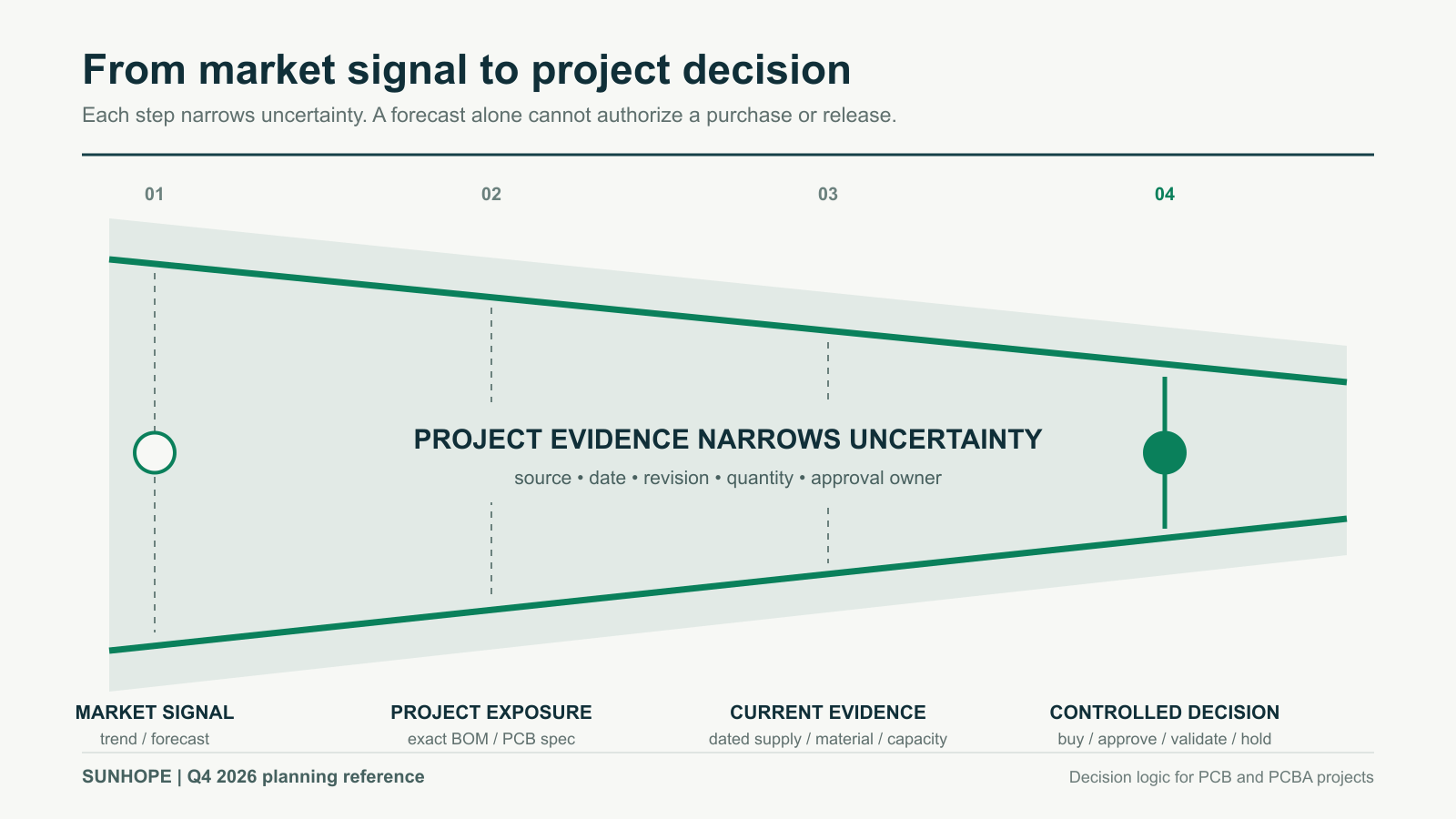
For a PCB or PCBA buyer, market direction is an early-warning signal rather than a purchasing instruction. The controlling evidence remains the exact bill of materials, approved sources, PCB construction, manufacturing route, inspection and test scope, quotation assumptions, and confirmed delivery basis for the project. Q4 planning should therefore identify the small number of items that can change cost, schedule, validation, compliance, or product continuity.
Information in this outlook was reviewed through October 4, 2026. It is a planning reference, not a supplier quotation or a guarantee of future price, lead time, capacity, allocation, or freight conditions.

Q4 2026 Outlook at a Glance
| Signal | Verified Q4 reading | Project implication |
|---|---|---|
| AI and semiconductor investment | Growth remains concentrated in leading-edge logic, memory, test, packaging, and data-center infrastructure. | Do not translate broad semiconductor growth into availability for every BOM line. |
| Memory | Q4 contract prices are rising, with the strongest pressure in server and enterprise-storage categories. | Confirm technology, density, package, grade, quantity, quote basis, and validity. |
| PCB materials | Cost and availability pressure is most visible in selected laminates, prepregs, copper foil, glass cloth, and high-performance inputs. | Freeze approved material rules and verify the exact stack-up before release. |
| End-market and regional conditions | Demand remains uneven by application, technology, manufacturer, and geography. | Use market data for screening, then obtain project-specific confirmation. |
| Trade and logistics | Goods trade is resilient, but policy, energy, freight, insurance, and route risk remain variable. | State freight, tariff, currency, delivery basis, and repricing assumptions in the quotation. |
The recommended posture is selective monitoring and project-level action. Broad speculative buying can create excess inventory, revision exposure, shelf-life risk, and cancellation liability without resolving the actual constrained line.
What Changed Entering Q4 2026
AI Investment Remains Strong but Growth Is Concentrated
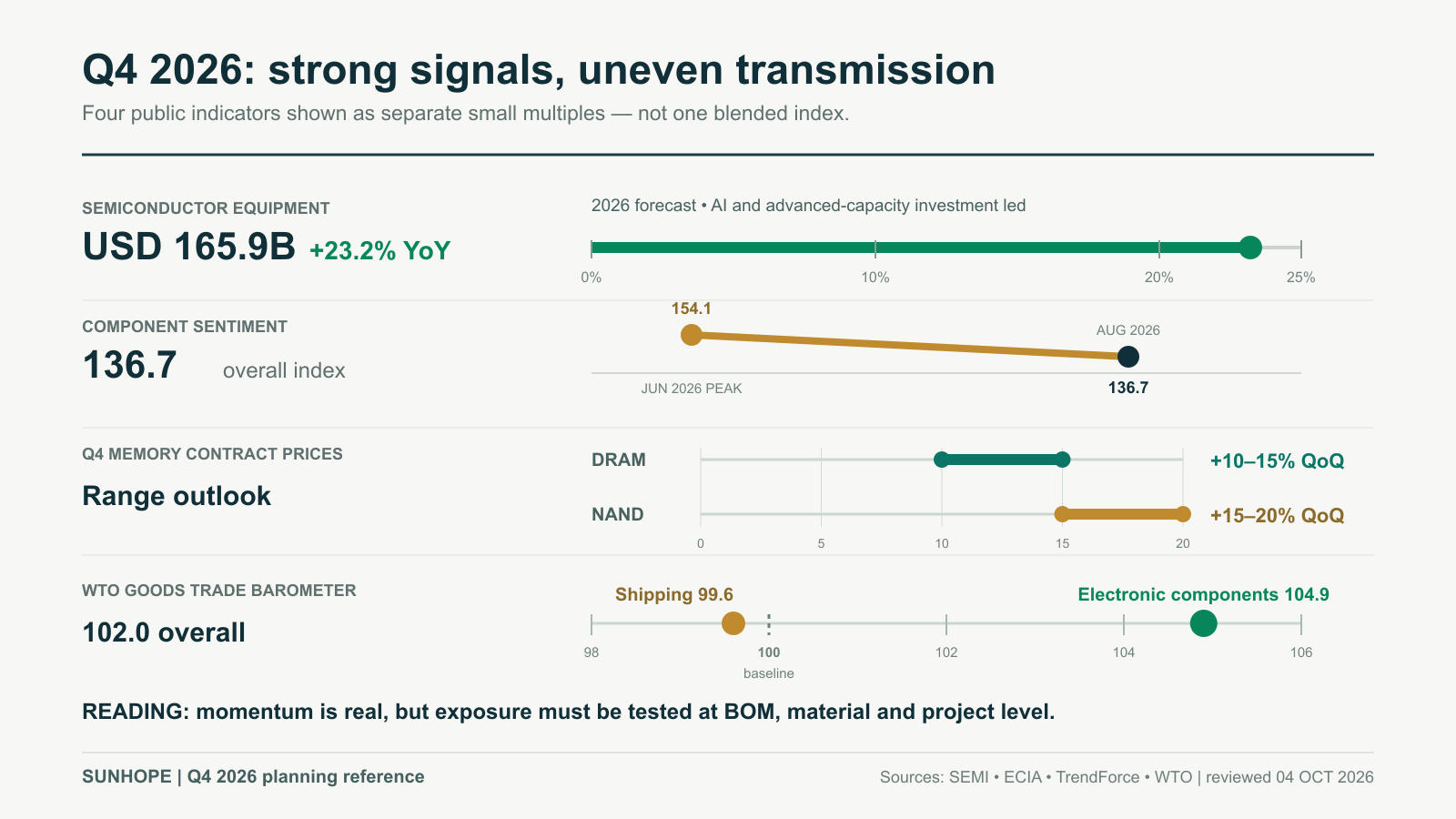
SEMI’s July 2026 forecast projects global semiconductor manufacturing equipment sales of USD 165.9 billion for 2026, up 23.2% year over year. Growth is led by leading-edge logic, advanced memory, test, and packaging for AI and high-performance computing. This confirms advanced-capacity investment; it does not show availability of the mature-node, analog, power, interface, or specialty devices used in a PCBA.
TPCA and ISTI of ITRI forecast global PCB output of USD 105.2 billion in 2026, up 13.9%, with AI servers and high-performance computing driving the shift toward higher-value board technology. A single supplier’s mix illustrates the concentration: TTM Technologies reported that data center and networking represented 40% of its Q2 2026 sales. That result is evidence about TTM, not proof that every PCB factory or standard multilayer line is at full capacity.
The practical question is where high-end demand shares inputs with a conventional project. Competition can occur in laminate families, copper foil, glass cloth, drilling tools, engineering attention, or committed factory slots even when the finished products are very different. Buyers should verify those shared dependencies instead of assuming that AI growth either affects everything or affects nothing.
Component Sentiment Remains Positive but Momentum Has Moderated
ECIA’s August 2026 Industry Pulse placed the overall component index at 136.7, down from the June peak of 154.1 but still above the preceding four-and-a-half-year range. Strong conditions and moderating sequential momentum can coexist. The data supports a segmented outlook rather than a claim of either universal recovery or an imminent industry-wide downturn.
Category-level sentiment should open a review, not close it. Two BOMs in the same end market can have different exposure because one uses widely available catalog parts while the other depends on a sole-source package, mature-node controller, custom magnetic component, approved connector, or firmware-bound processor.
Memory Pricing Has Strengthened but Categories Continue to Diverge
TrendForce’s September 30 Q4 outlook projects conventional DRAM contract prices to rise 10% to 15% quarter over quarter and NAND Flash contract prices to rise 15% to 20%. Server DRAM remains undersupplied, while enterprise SSD demand is especially strong. Consumer, mobile, client SSD, and niche memory categories show different purchasing and price dynamics.
A PCBA quotation should therefore identify the exact memory technology, manufacturer, density, package, speed, temperature grade, qualification grade, and approved alternatives. It should also distinguish distributor stock, spot material, contract supply, and a long-term agreement. A market percentage is not a valid substitute for the quoted part number, quantity, and purchase window.
PCB Material Cost and Availability Require Specification Level Review
Panasonic Industry’s 2026 price revision applied increases to glass-epoxy multilayer copper-clad laminate and prepreg, low-transmission-loss materials, CEM-3, and flexible circuit materials, citing raw-material, energy, and logistics costs. The published increases ranged from 15% to 30% by product group. This confirms a supplier-level cost change, but it does not mean every fabricator will apply the same adjustment to every project.
Würth Elektronik also reported pressure on copper-clad laminates, copper foil, selected prepregs, high-performance resins, and tooling materials as AI-related demand increased. Treat this as a reason to verify the exact material family, thickness, copper weight, prepreg construction, finished-board quantity, and delivery window. Standard FR-4, high-Tg, low-loss, halogen-free, metal-backed, and flexible materials do not share one supply base or one qualification path.
Trade Logistics and Regional Data Still Require Project Confirmation
The WTO Goods Trade Barometer released in September 2026 stood at 102.0, with the electronic-components index at 104.9 and the container-shipping index at 99.6. The reading indicates resilient electronics-related trade alongside a less uniform logistics picture. Regional order, shipment, and sentiment data should be interpreted within its sample; a North American index does not directly describe capacity in China, Taiwan, Southeast Asia, or Europe.
UN Trade and Development has also emphasized that disruption at maritime chokepoints can move quickly into freight, insurance, congestion, and schedule reliability. A quotation should therefore state its freight, tariff, currency, route, delivery-term, and validity assumptions instead of hiding them inside a single total price.
How Market Signals Translate Into PCB and PCBA Project Risk
Exact BOM Availability and Component Lifecycle
Begin with exact manufacturer part numbers, including package, grade, packing suffix, and customer-specific designations. For each critical line, record current lifecycle status, approved-source count, usable authorized inventory, quoted lead time, allocation conditions, demand coverage, approved alternatives, and the date and source of the check. Distributor search-result counts should not be treated as the number of independent approved manufacturing sources.
Use original manufacturer product pages, PCNs, PDNs, and documented confirmations as the primary lifecycle evidence. Aggregator and distributor tools are useful for screening a large BOM, but their normalized labels and stock listings should not override suffix-level manufacturer information or the project’s approved-source rules.
Flag parts that combine high project criticality with weak supply options: sole-manufacturer devices, long or unstable lead times, allocation-controlled items, NRND or EOL status, specialized packages or grades, and components whose replacement changes firmware, test, safety, EMC, or regulatory evidence. The complete decision process is covered in electronic component obsolescence management for PCBA projects. SUNHOPE does not replace an approved component part number without customer approval.
Bare PCB Material and Fabrication Readiness
Confirm that the quotation matches the released fabrication package. For double-sided and multilayer rigid PCB projects, review the approved laminate or performance class, finished thickness, copper weight, layer count, via structure, surface finish, panel requirements, controlled-depth features, tolerances, electrical test, and any impedance requirement that actually applies to the design. These details determine the qualified manufacturing route and can change material availability, panel utilization, process time, and delivery.
If an equivalent material is proposed, define who evaluates it, which properties must be compared, what customer approval is required, and whether product validation must be repeated. A generic statement that FR-4 is available is not enough when the project specifies a named material, thermal requirement, dielectric performance, flammability class, halogen-free system, or customer-approved stack-up.
PCBA Assembly Inspection Programming and Test Readiness
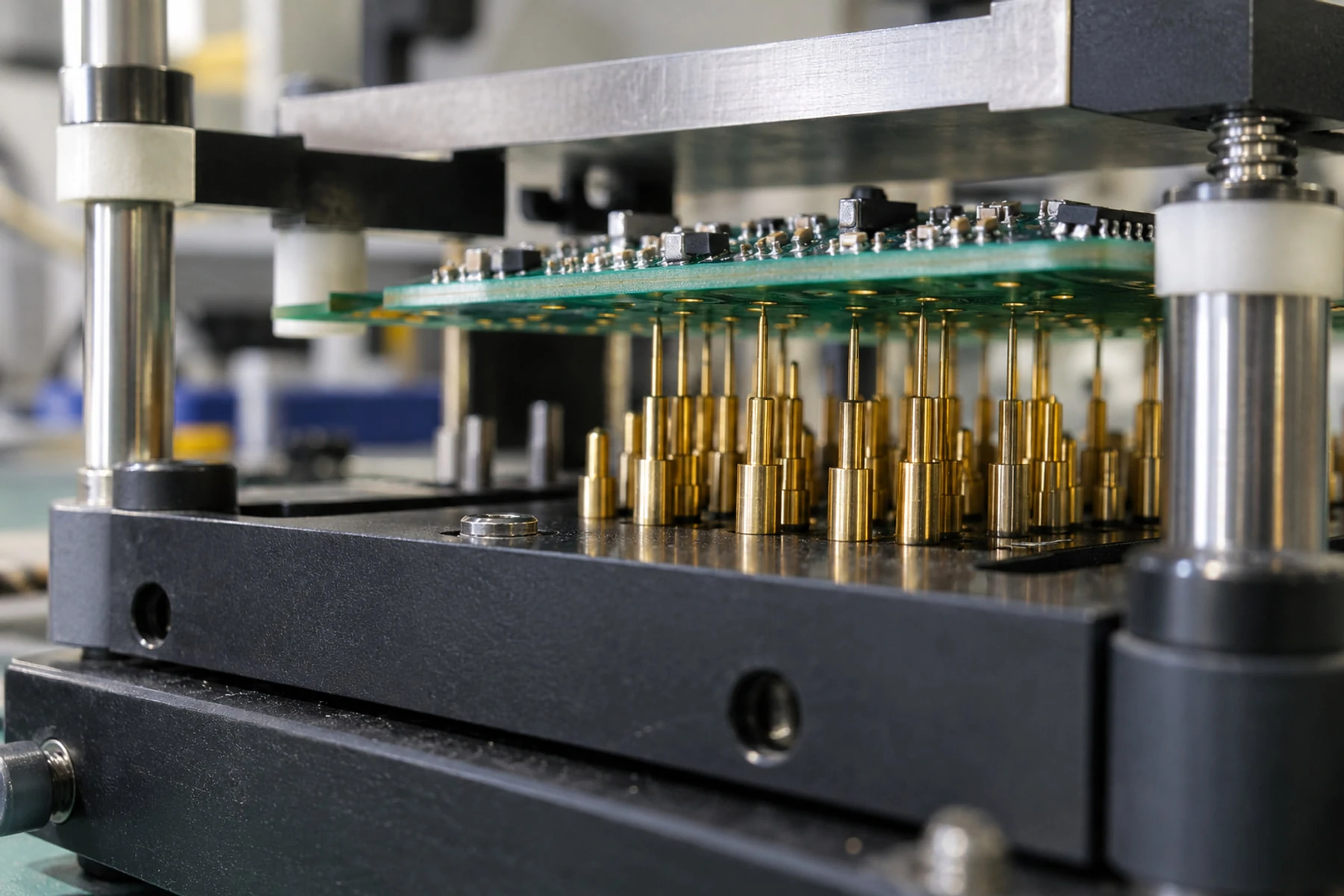
General SMT capacity does not establish readiness for a specific build. The project may require selective soldering, press-fit, BGA X-ray, conformal coating, cleaning, serialized data, device programming, burn-in, a customer-owned fixture, or a defined functional-test cycle. Confirm material readiness, line capacity, special processes, inspection resources, programming files, fixture status, test time, acceptance limits, and production records against one schedule.
For functional testing, SUNHOPE can execute customer-provided fixtures and programs, develop them within the confirmed scope, or coordinate with a qualified third party. The quotation should still define inputs, ownership, validation responsibility, and acceptance criteria. See the detailed guide to PCBA functional test requirements before quotation.
Quotation Validity Delivery Basis and Inventory Ownership
A usable quotation should show which assumptions may change before purchase release. Record the validity date, currency basis, quantity break, approved sources, component and PCB-material assumptions, freight and tariff treatment, minimum order quantities, non-cancellable or non-returnable terms, and the conditions that permit repricing. Distinguish an estimated lead time from confirmed material allocation and a committed production slot.
If the build date or quantity can move, identify which items require early authorization, who owns excess material, how cancelled demand is handled, and how stock is reserved to the approved revision. Requested delivery date and evidence-supported delivery date should appear as separate fields until the material and capacity plan is confirmed.
Q4 Actions by Project Stage
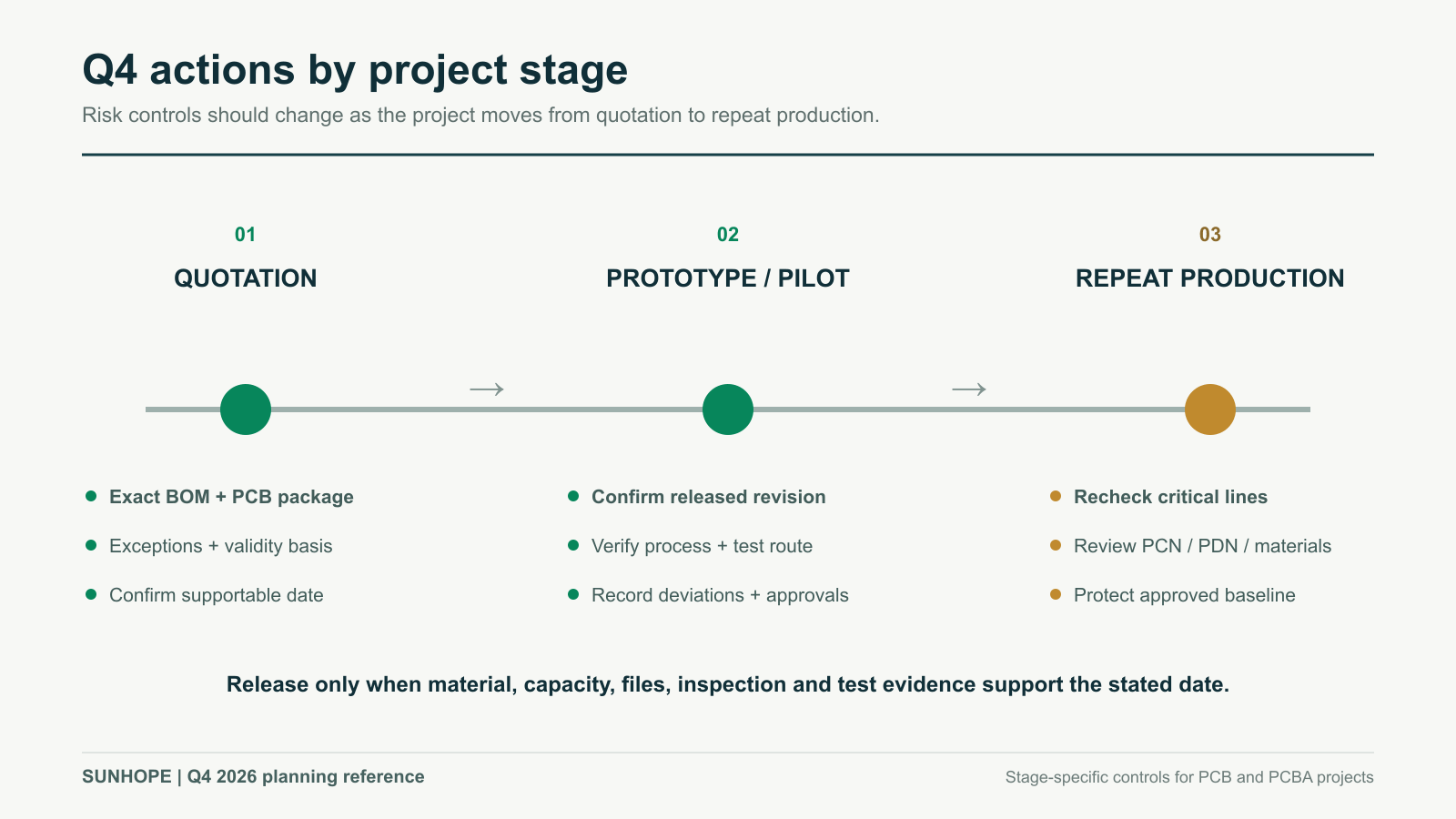
Projects Still in Quotation
- Provide a controlled BOM with exact manufacturer part numbers and clearly identified customer-approved alternatives.
- Provide the PCB fabrication package, approved stack-up or material rules, quantities, delivery location, and required dates.
- Request line-by-line exceptions for components and PCB materials instead of accepting a general statement that supply is available.
- Define quotation validity, repricing triggers, delivery basis, and ownership of excess or non-cancellable material.
- Separate requested delivery from the date supported by confirmed material, manufacturing, programming, inspection, and test capacity.
Prototype and Pilot Builds
- Confirm the released revision and approval authority before reserving scarce components or specified PCB materials.
- Do not introduce an availability-driven substitute merely to complete a prototype when it cannot support later qualification or production.
- Use the pilot build to verify material, process, programming, inspection, test, packaging, and traceability, not electrical function alone.
- Record deviations and link corrective actions to the released BOM, PCB files, assembly information, firmware, and test documents.
The wider release logic is described in the prototype to production ready PCBA process.
Repeat Production Orders
- Recheck critical BOM lines and approved PCB materials before every release rather than reusing an old availability assumption.
- Compare the new demand horizon with on-hand, committed, allocated, service, and non-cancellable inventory.
- Review open PCNs, PDNs, lifecycle changes, manufacturer changes, and customer-approved alternate status.
- Confirm that programming files, firmware, test limits, labels, packaging, and inspection libraries match the released revision.
- Hold the release when new supply, material, or technical information breaks the approved production baseline.
Six Q4 Indicators and Escalation Triggers
| Indicator | What to record | Escalation trigger |
|---|---|---|
| Component availability and lead time | Exact MPN, approved source, usable quantity, lead time, allocation, check date | Coverage no longer supports the build or service horizon |
| Memory and processor quotations | Technology, density, package, grade, quantity, quote basis, validity | Price, source, or allocation changes before purchase release |
| PCB material availability | Approved laminate or rule, prepreg, copper, supplier confirmation, check date | Unapproved equivalent or delivery outside the required build window |
| PCB and PCBA capacity readiness | Fabrication slot, SMT and THT slots, special processes, programming and test | One required process or resource is not reserved or aligned |
| Supplier quotation validity | Expiry, currency, freight, tariff, delivery basis, repricing and NCNR clauses | Project release will occur after validity or an assumption changes |
| Demand and inventory coverage | Forecast, firm orders, service demand, cancellations, committed and excess stock | Material commitment exceeds approved demand or demand exceeds coverage |
Use trend direction and exceptions instead of one composite score. An indicator becomes actionable when it changes a defined project decision: order timing, source approval, validation scope, inventory exposure, manufacturing route, or delivery commitment. Assign an owner and review date to each escalated item.
How Not to Misread the Q4 Outlook
AI Growth Does Not Mean Every Electronics Market Is Expanding
AI-related revenue and investment can rise while other applications remain cautious, inventory-sensitive, or price-sensitive. End-market data provides context; it does not replace the demand forecast and approved material plan for the customer’s product.
Industry Lead Times Do Not Prove Project Availability
A market-average lead time can improve while a sole-source package, mature-node device, qualified connector, named laminate, or test fixture remains constrained. Capacity also depends on construction, material, panel size, tolerances, certification, lot size, special processes, and location. Confirm the exact part, board, process, quantity, and delivery window.
A Market Forecast Does Not Reserve Material or Capacity
A forecast does not approve an alternate, reserve stock, commit a production slot, or guarantee delivery. The controlling evidence for release is the current, part-specific and material-specific confirmation tied to approved project files and customer decisions.
Frequently Asked Questions
Is the Electronics Supply Chain Fully Recovered in Q4 2026?
No single answer applies across the industry. Semiconductor investment, electronics-related trade, and component sentiment are comparatively strong, but conditions remain uneven by application, manufacturer, technology, package, material, and region. One critical BOM line can still delay a project when the wider market is growing.
Are PCB and PCBA Lead Times Expected to Increase?
Some lead times may increase where a project depends on constrained materials, advanced board construction, allocated components, or specialized assembly and test resources. Standard double-sided and multilayer work may remain stable when its materials and processes are readily available. Request confirmation for the actual construction, material set, quantity, process route, and delivery window.
Which Components and Materials Require the Closest Monitoring?
Prioritize items that combine project criticality with weak supply options: sole-manufacturer parts, long or unstable lead times, allocated devices, memory or processors with tight specifications, NRND or EOL parts, specialized grades, named PCB materials, and changes that require firmware, safety, EMC, functional, or regulatory validation.
Should Buyers Place Orders Earlier Because of AI Demand?
Only when project evidence supports the decision. Early purchasing can reduce schedule risk, but it can also create excess inventory, revision exposure, shelf-life concerns, cash commitment, and cancellation liability. Confirm demand, revision, source, price, storage conditions, required approvals, and inventory ownership before authorizing an early buy.
Next Step for a PCB or PCBA Project
For a project-specific Q4 review, provide the current BOM with exact manufacturer part numbers, the PCB fabrication package and approved material rules, build quantities and dates, product-life and service demand, inspection and test requirements, delivery location, and customer change-control conditions. These inputs allow market signals to be tested against the actual project instead of applied as general assumptions.
A useful review output should identify confirmed conditions, open assumptions, exceptions, responsible decision owners, required approvals, and the date each high-risk item must be checked again. It should also distinguish information needed before quotation, before material commitment, and before production release.
Within a PCB or PCBA manufacturing project, SUNHOPE can review manufacturing impact, organize open material and sourcing assumptions, identify items that need customer decisions, and coordinate the approved response. Review the relevant PCBA technical capabilities, PCB and PCBA quality assurance process, or contact the PCBA manufacturing support team with the controlled project inputs. Component coordination remains part of the manufacturing project and is not presented as a standalone component-distribution service.